
You have a product that is losing people somewhere, and two honest ways to find out where. Option one: run an automated UX audit yourself, get a scored list of problems back in minutes, and start working through it the same afternoon. Option two: hire a UX agency, brief them, and wait a few weeks for a considered report from people who do this for a living. Both are real UX audit services. Both will tell you things you did not know. They just cost wildly different amounts and find genuinely different problems, and the trick is knowing which gap you actually need to close right now.
This comparison is deliberately even-handed. If you finish reading and conclude that an agency is the right call for your situation, that is a good outcome, not a lost one. Hiring the right help at the right moment beats forcing a cheap tool onto a problem it was never built to solve. So here is the real trade-off, dimension by dimension, with the cases where each one wins.
If you want the underlying method both approaches are really running, our complete UX audit guide covers what a thorough audit looks like end to end. This piece is about who should run it, and how.
The short version
An automated UX audit is fast, cheap, consistent, and systematic. It is very good at catching the rule-shaped problems: accessibility failures, weak visual hierarchy, inconsistent components, generic error states, the things a large body of usability convention already has an answer for. It is blind to anything that depends on knowing your specific user, your business, or your intent.
A UX agency is slow, expensive, and bespoke. It is very good at the parts a machine cannot touch: interviewing real users, judging which friction is load-bearing and which is noise, reading a novel interaction on its own terms rather than grading it against a checklist, and designing the fix instead of only naming the flaw. It is an expensive way to catch a missing alt attribute.
Most of the tension between the two comes down to that split. One scales rule-checking to near-zero cost. The other brings human judgement you pay a professional rate for. Neither is a scam and neither is magic.
Cost
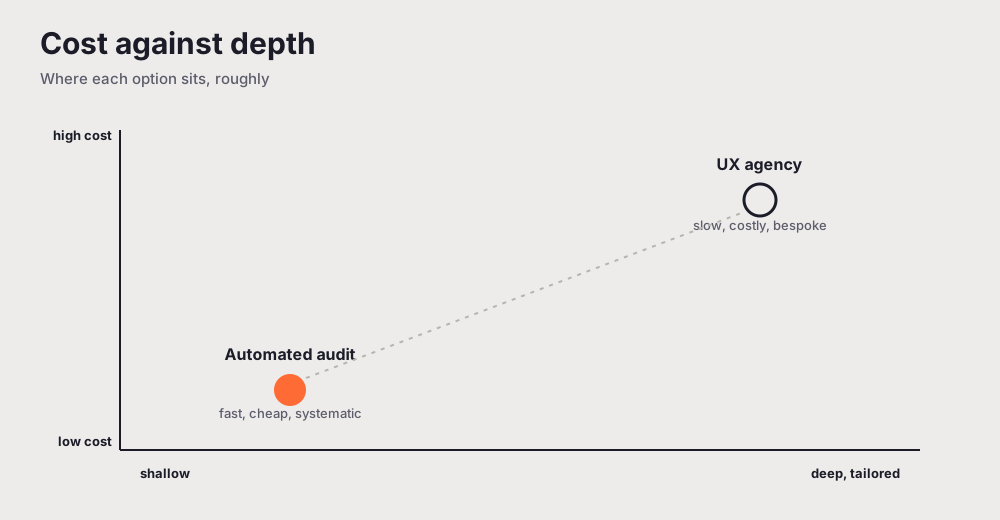
This is the most visible difference, so start here and get it out of the way. Automated UX audit services range from free for a first audit to a modest monthly subscription. The reason is simple: the marginal cost of a machine reviewing one more page is almost nothing, so the pricing reflects software, not labour.
A UX agency or an independent consultant is selling expert time, and expert time is not cheap. An engagement usually lands somewhere in the four to five figure range, driven by scope, how much primary user research is involved, and the seniority of the people on it. A quick heuristic review from one experienced consultant sits at the low end. A full research-led audit with recruited participants, moderated sessions, and a detailed report sits much higher.
The mistake is to read this as cheap versus expensive and stop there. What you are really buying at each end is different. The tool gives you systematic coverage at almost no cost per run. The agency gives you a human who can tell you why your best customers churn, which is not a thing a rulebook knows. You are not overpaying for the same output. You are paying for a different one.
Speed
If cost is the visible difference, speed is the one that changes how you work. An automated audit turns around in minutes. You give it a URL, it sweeps the product, and you get a scored, prioritised list you can act on before lunch. That speed is not just convenience. It changes the audit from a project you commission into a check you run, which means you can run it often.
An agency engagement runs on human time and calendars. There is scoping, then research, often a round of user sessions, then analysis, then a written report and a readout. Weeks, not minutes, and that is normal for good work. The output is deeper, but you cannot rerun it next Tuesday because a release changed three flows.
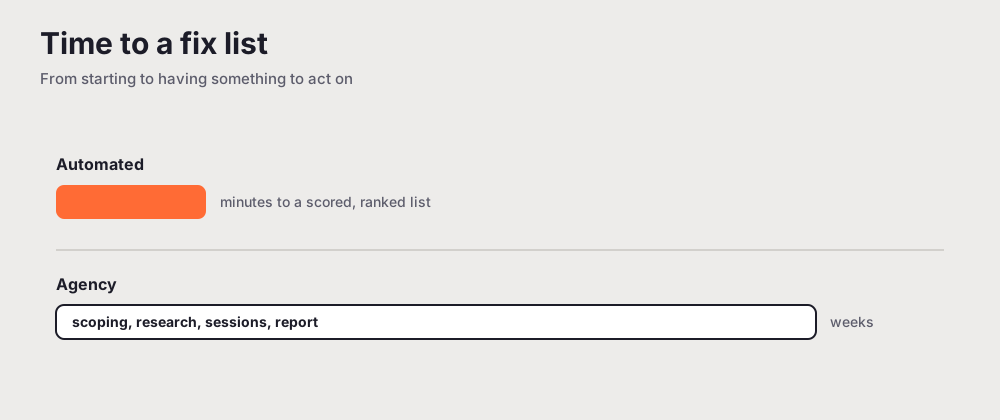
The practical consequence: automated audits fit into a sprint cadence, and agency audits fit into a quarterly or annual rhythm. If you need to know what is broken before a launch on Friday, the calendar has already made the decision for you.
Depth
Here is where the agency earns its price, so this is the part an honest comparison cannot skip. A good automated audit is broad and shallow by design. It checks a lot against known conventions, fast, everywhere. What it cannot do is understand context. It cannot tell that a five-step flow is five steps because a regulator requires it, so it flags the length as friction. It grades a genuinely new interaction as an error because the new thing is not in its rulebook yet. And it cannot know the deep qualitative why: the real reason a specific person abandoned your checkout, which lives in that person's head and nowhere a tool can reach.
A skilled human closes exactly those gaps. They weigh trade-offs. They interview real users and watch where people struggle instead of inferring it. They decide which of forty findings actually matter for your business, and they design the change rather than handing you a problem statement. That interpretation layer is the thing you are paying an agency for, and for a novel or high-stakes product it can be worth a great deal. We wrote more about the boundary between the two in what an AI UX audit catches and what it misses, which maps the machine's blind spots in detail.
Depth is also where the honest caveat lives on the other side. An automated audit does not replace watching real users, and neither does a founder clicking through their own product. If the answer you need is behavioural, someone has to observe behaviour, and an agency can run that where a tool cannot.
When each one is the right call
Put cost, speed, and depth together and the decision usually makes itself. It is less about which service is better and more about which question you are asking this quarter.
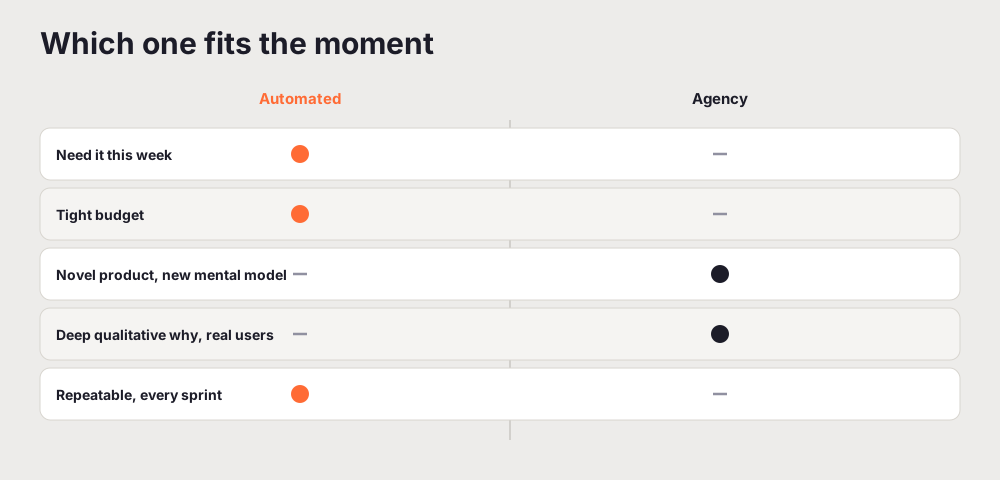
An automated UX audit is the right call when:
- You need answers this week, before a launch, a raise, or a big traffic push.
- Budget is tight and the systematic layer is where your obvious problems live.
- You want a repeatable baseline you can rerun every sprint to catch regressions.
- The product is fairly conventional, so grading it against known patterns is fair.
- You want to sharpen a brief before spending on human help.
A UX agency is the right call when:
- The decision is expensive, like a full redesign, and getting it wrong costs more than the engagement.
- Your product uses a genuinely new mental model that a rulebook would misread.
- You need real users interviewed and watched, not pages scored.
- A flow is regulated or high-stakes, where the qualitative why carries real risk.
- You have the systematic layer handled and need judgement, not coverage.
Here is the same split as a table, because comparison queries deserve one.
| Dimension | Automated UX audit | UX agency |
|---|---|---|
| Cost | Free to a modest subscription | Four to five figures per engagement |
| Speed | Minutes | Weeks |
| Depth | Broad, systematic, rule-based | Deep, tailored, human judgement |
| Real user research | Not included | Can run moderated sessions |
| Repeatability | Every sprint | Once or twice a year |
| Best for | Breadth, speed, baselines | Novel or high-stakes decisions |
The answer for most teams is not either or
The framing of this whole comparison is a false binary, and the best-run teams treat it that way. The two are not competitors so much as different stages. Run the automated pass first, because it is cheap and fast and clears the systematic issues across the whole product. Then, if the stakes justify it, bring in a human for the interpretation and the user research that a tool cannot do.
Sequencing them this way makes the expensive option cheaper and better. You are not paying an agency's hourly rate to find a low-contrast label or an inconsistent button, because the tool already flagged those. You walk into the engagement with a map of where the product breaks known conventions, so the consultant spends their time on the questions only a human can answer. If you decide to hire, running a tool first is how you get more out of the money. If you decide not to, the tool may well have covered what you needed.
For the systematic pass, you can run a free UX audit and have a scored, prioritised baseline in a few minutes, then decide from there whether the remaining gaps are worth an agency. If you are comparing the tools that do this, our roundup of the best UX audit tools walks through how they differ on accuracy, output, and price.
If you do hire, questions worth asking first
Say you have decided the stakes justify an agency. The gap between a useful engagement and an expensive report often comes down to a handful of questions asked before you sign. Ask who is actually doing the work, because agencies sometimes sell you a senior name and staff the project with a junior. Ask whether the audit includes real user research or is a heuristic review by an expert, since those are different products at different prices and both get called an audit. Ask what the deliverable is, and push for a ranked list of changes rather than a slide deck. Ask how they will prioritise, because a good consultant ties findings to your revenue and retention, not to their personal taste. And ask what happens after: some agencies hand over a report and leave, others stay to help you ship the fixes, and the second is usually worth more. None of these questions are hostile. They are how you make sure the money buys judgement rather than a document.
A note on what you do with the findings
Whichever route you take, the audit is only worth what you do next, and this is where both can quietly fail. An automated tool that dumps forty findings with no priority is as useless as a beautiful agency report that sits in a folder. The value is in a short, ranked list of changes tied to the flows that carry your revenue and retention. If your automated tool gives you severity and location, use it to triage hard. If your agency gives you a report, the first thing to ask for is the three changes that matter most, not the full inventory. The how to write a UX audit report that people act on guide is written for the agency side of that, but the principle holds for both: a list someone ships beats a document nobody opens.
The takeaway
Automated UX audit services and UX agencies are not really competing for the same job. One gives you systematic breadth, speed, and a price near zero, and it is right for most teams most of the time. The other gives you human depth, real user research, and tailored judgement, and it is worth every pound when the decision is novel or expensive. If you are not sure which you need, start with the automated pass. It is cheap enough to be a free first move, and it either solves your problem or tells you exactly what to hire an agency for.
Related reading: How to Write a UX Audit Report That Clients Actually Read
Frequently asked questions
What do UX audit services actually cost?
It splits into two very different ranges. Automated UX audit services run from free for a first audit to a modest monthly subscription, because a machine does the reviewing. A UX agency or independent consultant charges for expert time, so an engagement typically lands somewhere in the four to five figure range depending on scope, the amount of user research involved, and the seniority of the people doing the work. The honest way to read that gap is not cheap versus expensive. It is systematic coverage at near-zero marginal cost versus bespoke human judgement you pay a professional rate for.
Is an automated UX audit as good as a UX agency?
For different things, so the comparison is not clean. An automated audit is better at breadth, speed, consistency, and cost. It sweeps your whole product against known usability and accessibility conventions in minutes and never gets tired on the last few pages. An agency is better at the parts that need a human: interviewing real users, judging which friction is load-bearing, understanding a novel interaction, and designing the fix rather than only naming the problem. Neither is strictly better. They are strong at opposite ends, which is exactly why many teams end up using both.
When is hiring a UX agency worth it?
When the decision is expensive and the answer is not rule-shaped. A costly redesign, a product with a genuinely new mental model that a rulebook would misread, a regulated flow where the risk of getting it wrong is high, or a moment when you need real users interviewed and watched rather than pages scored. In those cases the qualitative why is the whole point, and that is human work. If you mostly need to know where your product breaks known conventions, an agency is an expensive way to get an answer a tool gives you in minutes.
Can I do a UX audit myself without hiring anyone?
Yes, and most teams should start there. Run an automated audit for a scored baseline, then walk your two most important flows as a first-time user and note every place you hesitate or get stuck. That combination catches the loud, systematic problems and the obvious friction, which is usually most of what is actually costing you signups. You bring in an agency later, if at all, for the deeper qualitative work that a solo pass and a tool cannot cover.
Should I run an automated audit before hiring an agency?
Almost always, yes. An automated pass clears the systematic and accessibility issues cheaply, so you are not paying expert hourly rates for a consultant to catch a missing alt attribute or an inconsistent button label. It also sharpens the brief: you walk into the engagement knowing where the product breaks the rules, so the agency can spend its time on the harder questions only a human can answer. Running the tool first tends to make the agency engagement both cheaper and more useful.